Project Overview
As the primary member spearheading this project, the focus is on continuous monitoring and prediction of faults in machine elements, specifically shafts and bearings in large machinery like gas turbines. The project leverages real-time vibration-based sensor data and employs intelligent analytics, particularly exploring Machine Learning techniques for fault detection and diagnosis.Objectives and Contributions
The primary objectives of this research include:- Continuous monitoring of machine elements to predict and prevent catastrophic failures.
- Exploration of suitable Machine Learning algorithms for fault detection in vibration-based signals.
- Investigation of dimensionality reduction techniques for identifying single faults in a cracked rotor.
- Exploration of clustering algorithms for detecting multiple faults in bearings.
The key contributions of this work are in advancing the understanding and application of Machine Learning techniques in fault detection, particularly showcasing close agreements with experimental observations.
Significance and Problem Statement
Machine elements in large machinery are prone to faults due to continuous operation and harsh conditions, necessitating continuous monitoring and early detection to prevent catastrophic failures. The project addresses this critical need by leveraging real-time vibration-based sensor data and applying statistical algorithms to decipher fault-related features.Problem Statement
The need for continuous monitoring and early fault detection in machine elements, such as shafts and bearings, to avoid catastrophic failures and ensure uninterrupted operation.Methodology and Technology Stack
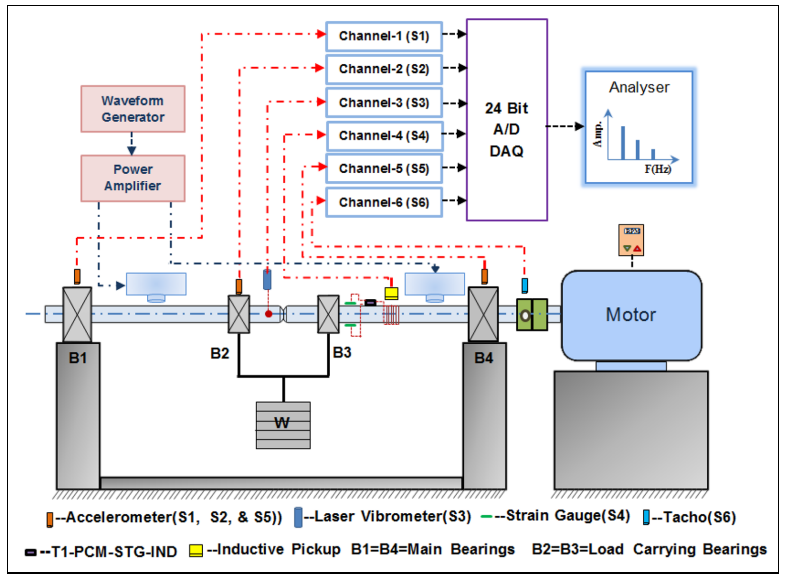
The project explores four dimensionality reduction techniques for single fault identification in a cracked rotor and investigates two clustering algorithms for multiple faults in bearings. The datasets used are collected from experimental facilities, providing real-world scenarios for algorithm testing. The technology stack includes:- Machine Learning Algorithms: Employed for fault detection and diagnosis in vibration-based signals.
- Dimensionality Reduction Techniques: Explored for identifying single faults in a cracked rotor.
- Clustering Algorithms: Investigated for detecting multiple faults in bearings.
- Experimental Datasets: Collected from suitable facilities, ensuring realistic testing scenarios.
Conclusion
The close mutual agreement between the algorithms and experimental observations in predicting the onset of faults in both rotor and bearing datasets showcases the effectiveness of the applied Machine Learning techniques. This research contributes to the advancement of fault detection methodologies, particularly in the context of large machinery with critical machine elements.Quick Links